On this page
EU AI Act Article 4 is the rule that asks companies to take measures to support the AI literacy of the people who use AI. Since 27 July 2026 it no longer asks employers to "ensure a sufficient level" of AI literacy. It asks them to "take measures to support" it.
This guide is for HR and L&D teams. It gives the amended wording, who it covers, what enforcement means since 2 August 2026, what counts as a measure, and a 30-day plan. Each legal statement links the official text, and where a sentence is our reading, it says so. It is not legal advice.
What EU AI Act Article 4 says, word for word
The amended paragraph 1 of Article 4 reads, in the consolidated AI Act of 27 July 2026:
"Providers and deployers of AI systems shall take measures to support the development of AI literacy of their staff and other persons dealing with the operation and use of AI systems on their behalf, taking into account their technical knowledge, experience, education and training and the context the AI systems are to be used in, and considering the persons or groups of persons on whom the AI systems are to be used. This obligation does not require providers or deployers to guarantee any specific level of AI literacy of any individual."
A second paragraph says the Commission and the Member States support providers and deployers, SMEs in particular, and that the Commission publishes practical examples. The change was made by Regulation (EU) 2026/1744, known as the Digital Omnibus on AI, which amends Regulation (EU) 2024/1689.
Article 4 before and after the Omnibus
Original text (2024)
- "ensure, to their best extent, a sufficient level of AI literacy"
- A duty of result, in our reading
As amended (27 July 2026)
- "take measures to support the development of AI literacy"
- "does not require ... to guarantee any specific level of AI literacy of any individual"
Regulation (EU) 2024/1689 and its consolidated version of 27 July 2026, EUR-Lex.
From "ensure" to "take measures"
The original Article 4 required providers and deployers to "ensure, to their best extent, a sufficient level of AI literacy". Three things changed:
- The verb. "Take measures to support" replaces "ensure". What you must show is what you did, not what every person can do.
- The sentence that closes it. No provider or deployer must "guarantee any specific level of AI literacy of any individual".
- The criteria stayed. Knowledge, experience, education, training, the context of use and the people the systems are used on still shape the measures.
Calling this a move "from an obligation of result to an obligation of means" is our reading, not the text's. It is a fair summary, though: the duty did not disappear. The adopted text kept the companies' obligation.
Who Article 4 covers: providers, deployers, contractors
The duty falls on two roles of the AI Act, providers and deployers of AI systems. Our reading: a company that builds an AI feature into its product is typically a provider, and one whose claims team uses an AI assistant is typically a deployer. Many companies are both.
Who Article 4 covers
The duty falls on
- Providers of AI systems
- Deployers of AI systems
- Many companies are both
The people to support
- Their staff
- Others using AI on their behalf
- Our reading: agency, freelancers, outsourced teams
Roles and wording from Article 4; the examples are our reading, not legal advice.
The people to support are wider than employees: "their staff and other persons dealing with the operation and use of AI systems on their behalf". Our reading is that this includes agency staff, freelancers and outsourced teams who use your AI tools for you. Put them on the list from the first day.
Two practical consequences for L&D:
- A deployer's duty does not need an AI project. Our reading: if staff use an assistant to draft emails, summarise contracts or write job ads, someone in the company is a deployer.
- The context changes the measure. Recruitment and selection are high-risk uses (Annex III, point 4(a)). Our reading: the measures for a recruiter screening CVs with AI should go further than those for a colleague rewording a newsletter.
The Act defines AI literacy in Article 3, point 56. For what to teach each role, see our guide to AI training for employees and the plan in how to train employees on AI.
Enforcement since 2 August 2026
Article 4 has applied since 2 February 2025. What changed this summer is supervision. The Commission's official timeline says that from 2 August 2026, "enforcement of the AI Act starts at national and EU-level concerning general-purpose AI models, prohibitions, transparency rules and AI literacy".
Article 4 on the calendar
- 2 February 2025Article 4 appliesTo providers and deployers
- 27 July 2026Omnibus text in force"take measures to support"
- 2 August 2026Enforcement startsNational and EU level, AI literacy included
EUR-Lex consolidated text; Commission AI Act timeline.
Enforcement starts at national and EU level. In Germany, for example, the Bundesnetzagentur supervises the AI Act's application (KI-MIG, § 2, in force since 29 July 2026). This guide does not cover penalties: check your Member State's rules or ask counsel.
What this means for you, in our reading: with enforcement started, the sensible position is to be able to show dated measures. Nothing here guarantees how a supervisor will assess them.
What counts as a measure (and what is weak evidence)
Our reading: Article 4 prescribes no course, no certificate and no hours. It lists what the measures must take into account. So a measure is anything that plausibly supports AI literacy for a given group in a given context. The test is whether you can show that you thought about who uses what, and acted on it.
Measure and evidence: weak and strong
Weak evidence
- Video nobody was asked to watch
- Certificate not tied to real tools
- One policy PDF, sent once
Stronger evidence
- List of AI tools and users
- Training by role, with dates
- Practice on real tasks, recorded
Tokenacademy's reading of Article 4, not a legal test.
Article 4's criteria, with a measure that answers each:
- Technical knowledge: different entry points. A finance analyst and a receptionist do not start in the same place.
- Experience and training: a baseline check, such as a short quiz or a first exercise, not a signature.
- Context of use: training on the tools and tasks in use. HR practises on job ads and CV screening, claims handlers on claim summaries.
- Persons affected: extra care where people are assessed, for anything that touches hiring, performance or customers' rights.
Four kinds of evidence (our reading)
- An inventory. Which AI tools are used, by which teams, for which tasks. Without it, nothing else is tied to reality.
- A matrix of roles and measures. Who gets what, and why that fits their use.
- Proof of practice. Videos show who clicked. Practice shows what people did. A learner who rewrote a vague request into a precise one on a real project has shown a skill, and that is evidence tied to a real tool and a real role. Video, workshop or hands-on practice online compares what each format can show.
- A dated record. Who owns the programme, when measures started, when you will review them.
 A learner's request, checked for its four parts: context, task, guidelines and constraints.
Weak evidence
Our reading: a certificate from a vendor that does not match your tools is weak. So is a policy PDF sent once, or an attendance list for an optional webinar. They are not worthless, but they answer "did we send something?" and not "did we consider each group's context?".
A 30-day plan for L&D
This plan is built to produce evidence by the end of the month. It assumes you do not yet have a programme.
A 30-day plan for L&D
- Week 1MapList AI tools, teams, contractors using them
- Week 2GroupSort by role, experience, risk of use
- Week 3TrainStart real-task practice, first group
- Week 4RecordDate measures, name an owner, set review
Week 1: map. Ask each team lead which AI tools their people use, including assistants built into other software, and which tasks they use them for. Add contractors. Note any use in recruitment, selection or decisions about people: those get more attention. For a quick self-check that explains each answer, try the free AI literacy test.
Week 2: group. Put people into three or four groups by role and by the risk of their use. A common split is all staff, heavy users, people who build with AI, and managers. Write one line per group on what they should be able to do.
Week 3: train. Start with the group where the risk is highest. A time-boxed AI pilot program is a practical way to do that. Give them practice on their own tasks, not a generic video. A guided session with a real agent, in which the learner asks for a result and the platform checks it, takes about 45 minutes. At Tokenacademy, milestones are validated automatically on the result, so no trainer has to sit with each learner. Our AI training for employees page shows how a programme is built; the enterprise AI training page covers sign-in, roles and learning paths. To compare providers on what learners actually do, see AI training platforms compared.
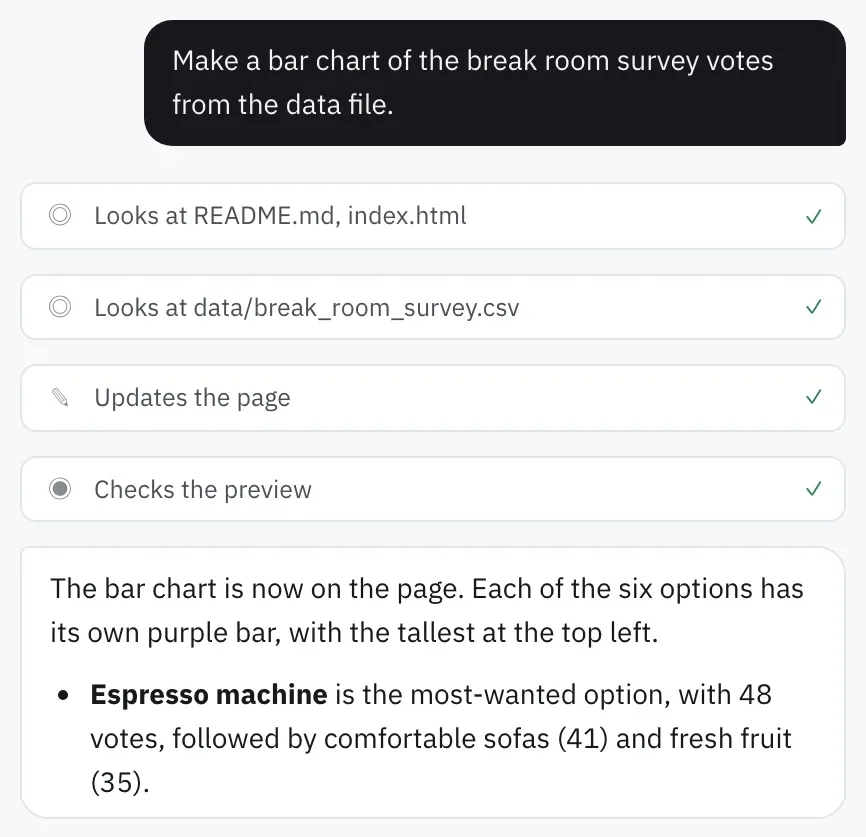 The learner asks for a result; the session lists each step the agent took.
Week 4: record. Date everything. Name an owner, set a review date, and keep the record with your other compliance files. Keep the business-impact story separate, as AI training ROI explains. Our free AI literacy checklist for Article 4 can help you note where you stand.
To see how hands-on practice fits your teams, book a demo.
FAQ
Is AI literacy mandatory under the EU AI Act?
Yes, for providers and deployers of AI systems: Article 4 requires them to take measures to support the AI literacy of their staff and of other persons using AI systems on their behalf. It does not require a certificate, and it does not require a guaranteed level for any individual.
What changed in Article 4 with the Digital Omnibus?
Regulation (EU) 2026/1744 replaced "ensure, to their best extent, a sufficient level of AI literacy" with "take measures to support the development of AI literacy". It added that the obligation does not require guaranteeing a specific level for any individual. The companies' duty remains.
When is Article 4 enforced?
Article 4 has applied since 2 February 2025. According to the Commission's timeline, enforcement concerning AI literacy starts at national and EU level on 2 August 2026.
Do I need a certificate for Article 4?
The text does not mention certificates. In our reading, a certificate can be one measure among others; evidence tied to your own tools, roles and practice shows more.
Does Article 4 apply to contractors and freelancers?
It covers "staff and other persons dealing with the operation and use of AI systems on their behalf". Our reading is that contractors and agency staff who use your AI tools for you are in scope. Confirm your own situation with counsel.
Does Article 4 apply to companies outside the EU?
It applies to providers and deployers as the AI Act defines them, and the Act's scope rules decide whether a non-EU company is one. This guide does not analyse those rules: take legal advice if you sell into the EU or use AI whose outputs reach it.
Sources
- Regulation (EU) 2024/1689, the AI Act, consolidated text of 27 July 2026: https://eur-lex.europa.eu/legal-content/EN/TXT/HTML/?uri=CELEX:02024R1689-20260727
- Regulation (EU) 2026/1744, the Digital Omnibus on AI: https://eur-lex.europa.eu/legal-content/EN/TXT/?uri=OJ:L_202601744
- Regulation (EU) 2024/1689, original text: https://eur-lex.europa.eu/eli/reg/2024/1689/oj/eng
- European Commission, AI Act Service Desk, timeline of implementation: https://ai-act-service-desk.ec.europa.eu/en/ai-act/timeline/timeline-implementation-eu-ai-act
- Germany, KI-MIG, § 2: https://www.gesetze-im-internet.de/ki-mig/KI-MIG.pdf