On this page
For a whole company, choose hands-on practice online, and keep a short video for the vocabulary and a workshop for the teams that will change a process together. There are three AI training formats a company can realistically offer to all its employees: a video course with a quiz, a live workshop, or hands-on practice online with a real AI agent. They do not teach the same thing, and they do not reach the same number of people. This article compares them on four questions, so that an HR or L&D team can see what each format gives up.
For the plan around the formats, read how to train employees on AI; for what to teach each role, the page on AI training for employees.
One hands-on session online, about 45 minutes
- The briefA short task, with milestones
- Learner's requestPlain words, to a real AI agent
- The agent buildsBuilds what they asked for
- Learner checksReads the result, decides changes
- Milestone validatedChecked on the result, no hand grading
The three AI training formats
Video + quiz. Employees watch recorded lessons, then answer questions to check what they remember. It is a quick way to reach many people, and the easiest to fit into a working week.
Live workshop. A trainer, a room (or a video call), and a group, usually for a day. People try the tools with someone beside them who corrects them. It works, but a trainer can only be in one room.
AI hands-on practice online. Each employee does a short guided session in the browser, about 45 minutes, working with a real AI agent on a real project. Nothing is installed, and the milestones are checked on the result without a trainer. This is the format Tokenacademy offers; the three are compared on the same questions.
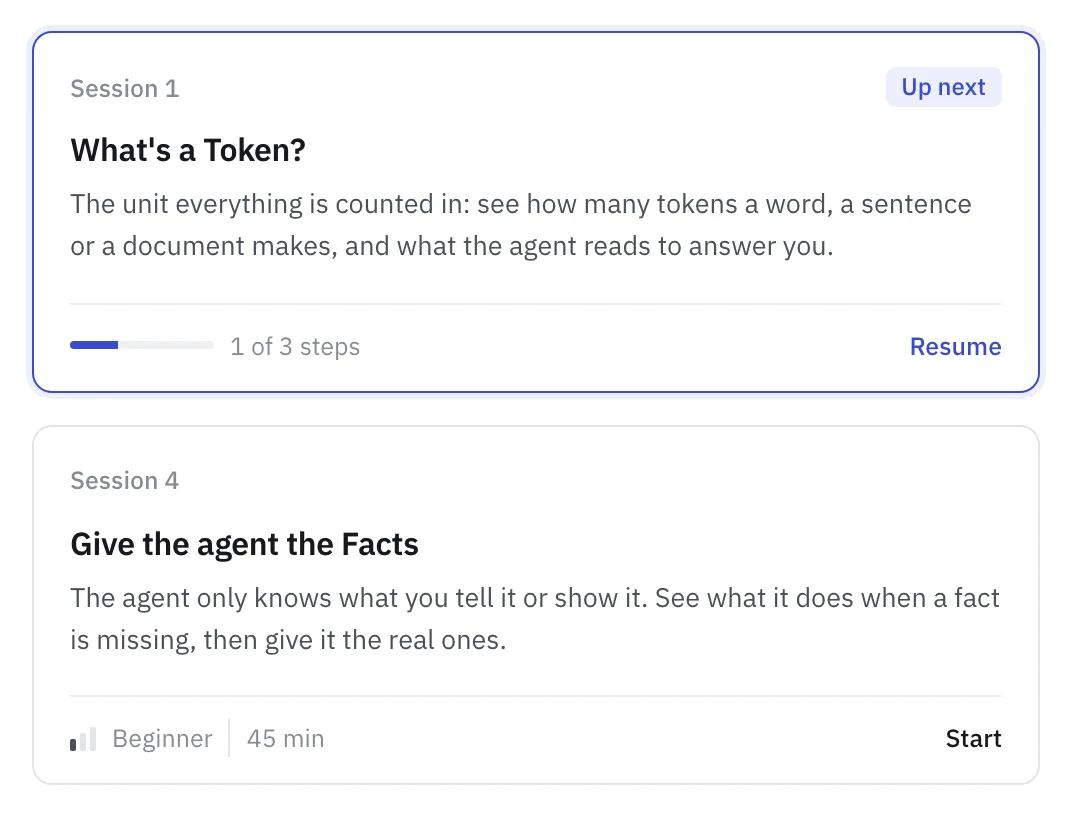 Each session is a card: one in progress, one not started, with its level and duration.
The comparison
Four questions decide whether an AI training format is worth buying: does each person do the task themselves, do they get feedback on what they made, can it reach everyone, and does it fit the working week? The figure answers them for the three formats.
Three AI training formats, four questions
Video + quiz
- Watch, don't do
- A quiz score
- Any number of viewers
- Any time
Live workshop
- Do the task, trainer beside you
- Trainer feedback on the spot
- One trainer, one room
- Needs a date and a day away
Hands-on practice online
- Do the task with a real agent
- Milestones checked on the result
- No trainer or room needed
- Sessions of about 45 minutes
The three formats on the same four questions.
Why video and a quiz fall short
A video shows someone else using an AI tool. The employee understands it while watching, and then opens a chat window the next morning with a blank prompt and unsure how to ask. A quiz on definitions checks that they remember words, not that they can get a result.
Video is still good at one job: giving everyone the same vocabulary, quickly. If your first goal is for people to know what a token or a context window is, a short video is a fair start. It should not be the whole programme.
What a workshop does well, and where it stops
A workshop makes people do the task, and a trainer corrects them on the spot. That is its strength, and a recording cannot do it. A first small project on the day also gives a team something to talk about afterwards.
The limits are logistics. One trainer fits one room, so a workshop reaches a few teams at a time. It needs a date, a room and a day away from the job, which is hard to repeat for thousands of people, and again for the colleague who joins next month. For a company of 1,000 employees or more, the question is rarely "is a workshop good?" and almost always "how many of us can attend?".
A live workshop: what it does well, where it stops
Where it stops
- One trainer fits one room
- Needs a date and a day away
- Hard to repeat for newcomers
What it does well
- Each person does the task
- Trainer corrects on the spot
- A first small project to discuss
The two sides of the workshop format.
Hands-on practice online: workshop-style practice at video scale
Practice online keeps what a workshop does, which is that every person does the task, and removes what limits it, which is the trainer and the room. The reasoning is in the thesis behind hands-on practice. In a Tokenacademy session, the learner reads a short brief, asks the agent for what they want in plain words, and reads the result. They never see code.
Three things make it different from a recorded course:
- Real agents. The learner works with a real AI agent, not a script of one, so a vague request gets a vaguer result than a precise one.
- Checked on the result. Milestones are validated automatically on what was produced: the page, the files, the agent's replies. A coach gives hints and feedback and never does the work for the learner.
- Fewer tokens. Some sessions cap the tokens a learner may spend, so they learn to get the same result with fewer tokens (see what a token is).
How to choose
Start from the outcome, not the format: write down one task you want people to do after the training, then ask which format makes them do it. A format that cannot show the task being done will not change how people work, however many people it reaches. See what to measure after AI training to check that it did.
You rarely need only one. In the EU, Article 4 of the AI Act asks providers and deployers of AI systems to "take measures to support the development of AI literacy of their staff", taking into account, among other things, their experience and the context the AI systems are used in (consolidated text of Regulation (EU) 2024/1689). It names no format, so the choice is yours. Our guide covers what counts as a measure under Article 4. A simple way to decide:
Choosing a format: start from the outcome
- Name one taskWhat should people do afterwards?
- Vocabulary for allA short video is enough
- Practice for allHands-on online: everyone does the task
- Conversation for some teamsWorkshop on their own cases
A simple way to decide; the formats can be combined.
- Everyone needs the vocabulary. A short video is enough for that.
- Everyone needs to practise. Hands-on practice online reaches every employee and still makes them do the task. Try it first with a small test cohort and a decision rule.
- Some teams need a conversation. A workshop on their own cases, for a team that will change a process together, is where a trainer is worth the day. If you write the content in-house, see creating the sessions yourself with AI.
If you want to see what a session looks like before deciding, book a demo; it is a 30-minute call where we get to know your project, then show you the platform. See also the best AI training for employees, hands-on AI training and AI adoption statistics for where companies stand.
FAQ
What is the best format for AI training for employees?
It depends on what you want people to be able to do. Video is a quick way to share vocabulary, a workshop gives live correction to a few teams, and hands-on practice online makes every employee do the task.
Is a live workshop better than a video course for AI training?
For learning to do the task, yes: in a workshop each person tries and a trainer corrects them, while in a video they watch. For reach, no: a workshop needs a trainer, a room and a day away from work.
Can online AI training be hands-on?
Yes, if it has people do the task rather than watch: a guided session in which the learner works with a real AI agent and is checked on the result is online and hands-on at once.
How long should an AI training session be?
Tokenacademy's sessions last about 45 minutes each.
Do employees need to know how to code?
No. Learners describe what they want in plain words and the agent does the rest. They do not read or write code.
Sources
- Regulation (EU) 2024/1689, the AI Act, consolidated text of 27 July 2026: https://eur-lex.europa.eu/legal-content/EN/TXT/HTML/?uri=CELEX:02024R1689-20260727