On this page
Tokenacademy did not start as a product. It started in training rooms. We taught people how to work with AI, live, in several countries, in some of the largest companies. This article is what we saw there, and how each thing we saw became a decision in our AI training for employees. The short version: learning AI by doing works, and a lot of what got in the way was not about AI.
One request in a Tokenacademy session
- The learner types a requestPlain words, in the browser
- The agent buildsA real agent, on a real project
- The result appearsBeside the chat, at once
- A milestone lights upMet automatically; on to the next
Where we come from
Before we built anything, we gave live, in-person AI trainings. People came with real jobs and real questions. We stood in front of them.
We watched what worked and what did not, and we changed our sessions again and again. Tokenacademy is built from what we saw.
What we saw in the room
Three things came back every time.
People get hooked when they see a result they made. Not a slide. Not a demo by the trainer. A page they asked for, appearing on their own screen right away. You could feel the room change. People got excited: seeing something you made appear on the screen gives a small hit of dopamine, and people wanted to do the next thing. That is what made the lesson stick.
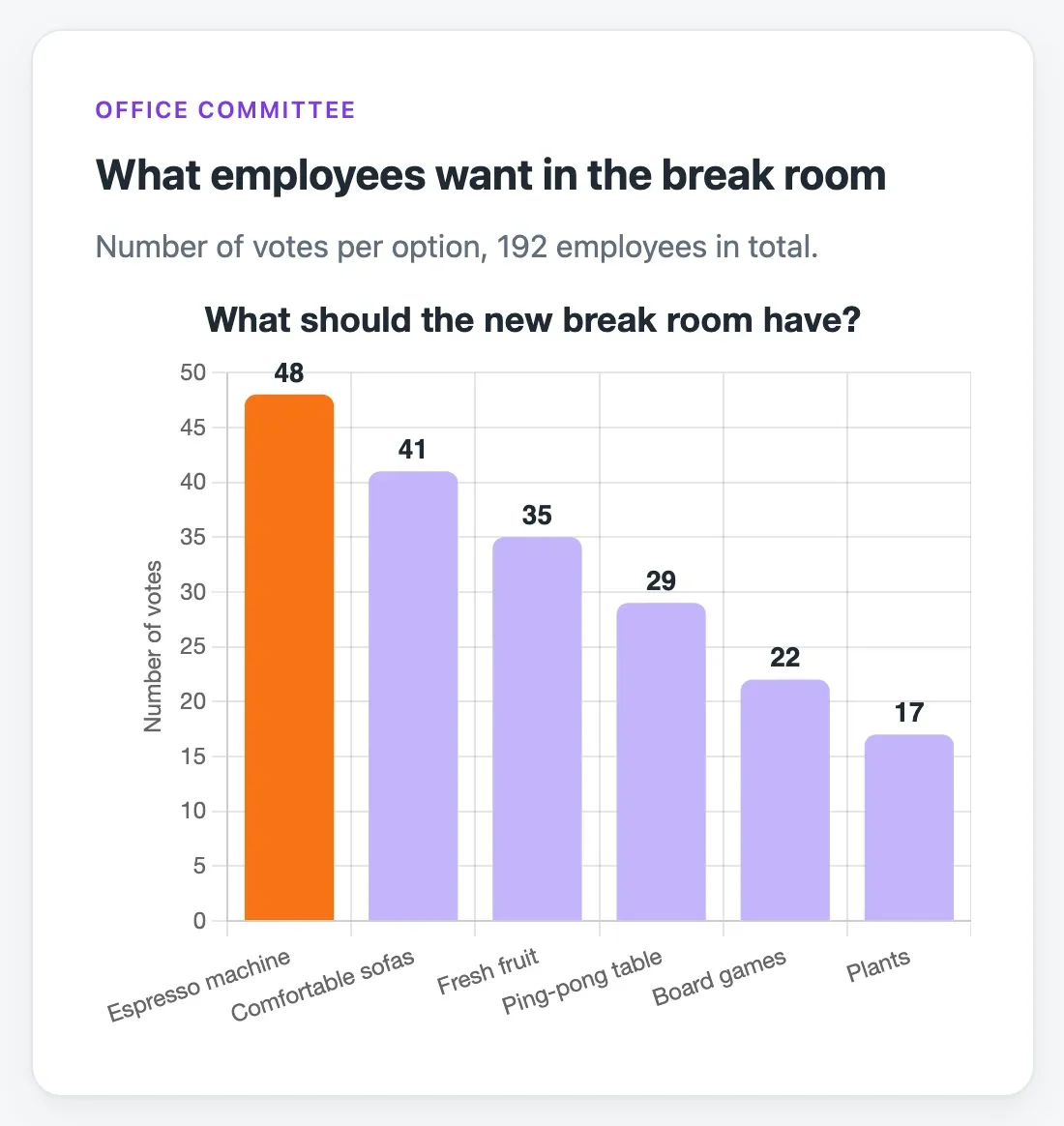 The result a learner asked for in an example session: a finished chart of a made-up survey.
People learn the real thing when they go end to end with the real tools. A simplified exercise teaches a simplified skill. When people used the agents the market uses, from the first request to a finished result, they learned what working with AI is really like. A demo of the tools did not do that.
Setup took a great deal of the time. On company computers, people needed rights to install software, accounts to create, keys and licences, and some company networks blocked the sites we needed. The command-line agents themselves start with an install command and a sign-in (Claude Code, Codex). All of this happened before a first request, and it took time we wanted to spend on AI.
What we built because of it
Each thing we saw became one decision.
What we saw in the room, what we built
The excitement of a result
- Saw: instant results keep people going
- Built: result shown beside the chat
The real tools
- Saw: people learn with work tools
- Built: real agents, end to end
Setup on company laptops
- Saw: setup took a great deal
- Built: nothing to install; browser sandbox
For more, read what an AI sandbox is for training, see our AI training sandbox, or learn what AI agents are.
What we believe: learning AI by doing
AI is a skill, and skills are learned by doing. You do not learn to ride a bike from a video of someone riding. Slides and videos can explain what AI is. They cannot give you the moment where you ask, something happens, and you understand.
So we think good AI training has three parts. People make something themselves. They use the real tools. And nothing stands between them and the first request. If one is missing, the training turns back into a presentation.
If you want to know how the main formats compare, read our guide to AI training formats, how to train employees on AI, or how to choose an AI training platform. This article is only about why Tokenacademy exists: we built the tool we wished we had in the room.
If you want to see it, book a demo. It is a 30-minute call: we get to know your project, then show you the platform.
FAQ
Who is behind Tokenacademy?
A team that gave live, in-person AI trainings in several countries, in some of the largest companies, before building the platform. What we saw in those rooms is what shaped it.
What problem does Tokenacademy fix that live training does not?
Setup. In live sessions, installs, accounts, keys and blocked networks on company computers took a great deal of the time. With Tokenacademy there is nothing to install: a sandbox is ready in the browser.
Do learners need to know how to code?
No. They describe what they want in plain words and look at the result.
Sources
- Claude Code overview, Anthropic's documentation: https://code.claude.com/docs/en/overview (checked 2026-11-15: terminal install command, login on first use).
- Codex CLI, OpenAI's documentation: https://learn.chatgpt.com/docs/codex/cli (checked 2026-11-15: install command, sign-in on first run).