On this page
These twelve prompt engineering exercises come from everyday work in HR, L&D, sales and operations. Each gives you a weak prompt, the task to do, a model answer, and the one part of a request it trains: context, task, guidelines or constraints. They need no code and no technical background, and you can run them with any AI assistant. If you want the full path behind them, see our prompt engineering training.
The four parts each exercise trains
- ContextWho it is for, situation, material
- TaskThe one thing to produce
- GuidelinesHow: tone, format, structure
- ConstraintsThe limits: length, what to avoid
How to use these prompt engineering exercises
A request to an AI agent has four parts. Context is the situation, the audience and the material. The task is the one thing to produce. Guidelines say how: tone, format, structure. Constraints set the limits: length, what to leave out, what never to do. A weak prompt leaves some of them for the agent to guess.
Vendors describe the same idea in their own words. Anthropic's guide suggests treating the model as a "brilliant but new employee who lacks context on your norms and workflows", and a test: show your prompt to a colleague with minimal context and ask them to follow it. OpenAI's guide compares a GPT model to a "junior coworker" who performs best with explicit instructions. Both links are in the Sources.
Work each exercise the same way:
- Read the weak prompt and name what the agent would have to guess.
- Write your own stronger version before you read the model answer.
- Run both in a new conversation each time and compare what comes back.
- Rewrite once more, fixing the one thing still missing.
How to work each exercise
- Read the weak promptName what the agent would guess
- Write your ownBefore reading the model answer
- Run both, compareSame agent, new conversation each time
- Rewrite once moreFix the one thing still missing
Do not copy the model answers word for word. They are one good version, with invented names and figures; yours should use your own. To check your own version quickly, paste it into the prompt checker, a free simulation that runs in your browser and shows which of the four parts it finds. No AI model is called.
Twelve exercises by part
Context (1-4)
- Job ad
- Customer reply
- Meeting summary
- Training invite
Task, guidelines (5-8)
- Onboarding plan
- Feedback survey
- Sales follow-up
- Process rewrite
Constraints (9-12)
- Policy FAQ
- Complaint reply
- Executive brief
- Candidate shortlist
Exercises 1-4: context
Context is what the agent cannot know unless you say it: who the text is for, what happened, what you already have. These four exercises each remove a guess about the situation.
Exercise 1: the job ad
Weak prompt: "Write a job ad."
Task: Produce a job ad for a role your team really needs to fill.
Model answer: "We are hiring an operations coordinator for our 12-person logistics team in Leeds. The person will schedule deliveries, answer carrier queries and report to the head of operations. Candidates will be early-career, reading this on a job board. Write the job ad in a warm, plain tone, with a short intro, five responsibilities and four requirements."
Trains: context. The weak prompt names no role, team or reader. The answer adds all three; the tone and structure at the end also touch guidelines.
Exercise 1, before and after
Weak
- No role to hire
- No audience
- No tone
- Agent guesses all three
Stronger
- Role and team named
- Candidate described
- Tone stated
- Little left to guess
Exercise 2: the customer reply
Weak prompt: "Reply to this customer."
Task: Answer an unhappy customer's email about a late order.
Model answer: "Below is an email from a customer whose order arrived five days late. We are an online shop selling kitchenware; our policy is a refund of the shipping fee for any delay over three days. Write a reply from our support team that apologises once, offers the shipping refund and says when it will arrive. Here is the email: [paste it]."
Trains: context. The agent needs the facts (the delay, the policy) and the material (the email itself). Without them it invents a policy.
Exercise 3: the meeting summary
Weak prompt: "Summarise these notes."
Task: Turn a page of rough meeting notes into something your team can act on.
Model answer: "These are my notes from a weekly sales meeting with six people. The readers are the three managers who were not there. Summarise the notes so they know what was decided and what they must do. Notes: [paste them]."
Trains: context. "Who reads it and what do they need from it" is context. The same notes give a different summary for the absent managers than for the team that attended.
Exercise 4: the training invitation
Weak prompt: "Write an invitation for the training."
Task: Invite 40 employees to a half-day workshop.
Model answer: "Our HR team is running a half-day workshop, 'Writing better requests to AI', on 12 March, 9:00 to 13:00, in room 3 and online. The 40 invitees work in claims handling and have not used AI at work before. Write the invitation email to them from the head of HR, explaining why they were chosen and what to bring."
Trains: context. Date, place, audience and their starting point are all context. The agent cannot find them anywhere else.
Exercises 5-8: task and guidelines
Here the situation is clear, but the request is not. Either the task is fuzzy ("improve", "help with") or the shape of the answer is left open.
Exercise 5: the onboarding plan
Weak prompt: "Help me with onboarding."
Task: Get a first-week plan for a new customer-success hire.
Model answer: "Create a first-week onboarding plan for a new customer-success representative who starts Monday. Give one row per day with three columns: morning, afternoon and who they meet. Keep it to activities that need no system access on day one."
Trains: task. "Help me with" is not a task. "Create a first-week plan" is. The row-per-day format is the guideline.
Exercise 6: the feedback survey
Weak prompt: "Make a survey about our training."
Task: Write the questions for a short survey after a workshop.
Model answer: "Write a post-workshop survey for 40 employees who attended a half-day AI workshop. Ask eight questions: five rated 1 to 5 and three open. Group them under 'Content', 'Delivery' and 'What next'. Use neutral wording; no question may suggest the right answer."
Trains: guidelines. The structure (eight questions, three groups) and the neutral wording are how the survey should look. The task was already clear.
Exercise 7: the sales follow-up
Weak prompt: "Write a follow-up email to a prospect."
Task: Follow up after a demo call with a head of finance.
Model answer: "Write a follow-up email to a head of finance who saw our demo yesterday and asked about integration with their accounting system. Open with a thank-you in one sentence, answer the integration question, then propose a 20-minute call next week. Formal but friendly, and end with one clear question."
Trains: task and guidelines. The task is the email and its single goal, a call. The order of the points and the tone are guidelines.
Exercise 8: the process rewrite
Weak prompt: "Improve this procedure."
Task: Make an expense-claim procedure easier for staff to follow.
Model answer: "Rewrite the expense-claim procedure below so that a new employee can follow it without asking anyone. Turn it into numbered steps, one action per step, and put the deadline at the top. Procedure: [paste it]."
Trains: task. "Improve" does not say in which direction. "Make it followable by a new employee" does, and the agent can now tell whether it succeeded.
Exercises 9-12: constraints
Constraints are the limits you would give a colleague without thinking: how long, what to leave out, what not to promise. An agent does not know yours.
Exercise 9: the policy FAQ
Weak prompt: "Write an FAQ about our leave policy."
Task: Turn a leave policy into an FAQ for staff.
Model answer: "From the leave policy below, write an FAQ of six questions staff really ask. Use only what the policy says. If it does not cover a question, write 'ask HR' rather than guessing. Each answer must be two sentences or fewer. Policy: [paste it]."
Trains: constraints. "Use only what the policy says" and the length limit are constraints. They stop the agent from adding rules that do not exist.
Exercise 10: the complaint reply
Weak prompt: "Reply to this complaint and make it good."
Task: Answer a complaint about a billing error.
Model answer: "Write a reply to the complaint below, under 120 words. Apologise once. Do not admit legal fault, do not promise compensation and do not blame another team. Offer a call with the billing manager. Complaint: [paste it]."
Trains: constraints. Each "do not" is a limit the agent could not infer. The word count keeps the reply short enough to send as it is.
Exercise 11: the executive brief
Weak prompt: "Summarise this report for the board."
Task: Give executives a one-page summary of a long report.
Model answer: "Summarise the report below for board members who will read it in two minutes. Maximum 150 words, three bullet points, each starting with the decision it supports. Leave out methodology and any figure that is not in the report. Report: [paste it]."
Trains: constraints. The word limit, the number of bullets and what to leave out all narrow the answer.
Exercise 12: the candidate shortlist
Weak prompt: "Pick the best candidates from these CVs."
Task: Prepare a shortlist for a role, with a person making the final decision.
Model answer: "Below are five CVs for an operations coordinator role. For each, list in two lines how they match the five requirements I gave. Do not rank the candidates, do not score them and do not use age, gender or nationality. A person will decide. CVs: [paste them]."
Trains: constraints. What the agent must not do (rank, score, use protected traits) is the point here. Recruitment is a sensitive use, so keep a person in charge of the decision.
Running these exercises with a team
Pick one exercise from each group and give each person ten minutes: they write their version, run it, and swap results with a neighbour. The discussion is the learning. Which guess did the agent make, and which part of the request would have prevented it? To check that the habit shows up in real work, see how to measure AI training effectiveness: the four parts can serve as a scoring grid.
Make it a weekly habit rather than a one-off. Take a real request your team sent last week, find which of the four parts it lacked, and rewrite it. A rewrite also saves tokens, because a vague request gets redone and a precise one is done once. For a more game-like drill, Prompt Golf asks you to turn a colleague's brief into one request in as few strokes as possible.
Examples only go so far; the skill comes from doing the task with a real agent. That is the idea behind Tokenacademy: hands-on AI training where each employee practises with a real AI agent on a real project, in the browser. Its Prompting with AI program teaches a request in four parts with prompt games. If you are planning this for your company, our page on AI training for employees and the article on the AI training sandbox explain where the practice happens, or you can book a demo. For the plan around these exercises, see the 90-day plan to train employees on AI.
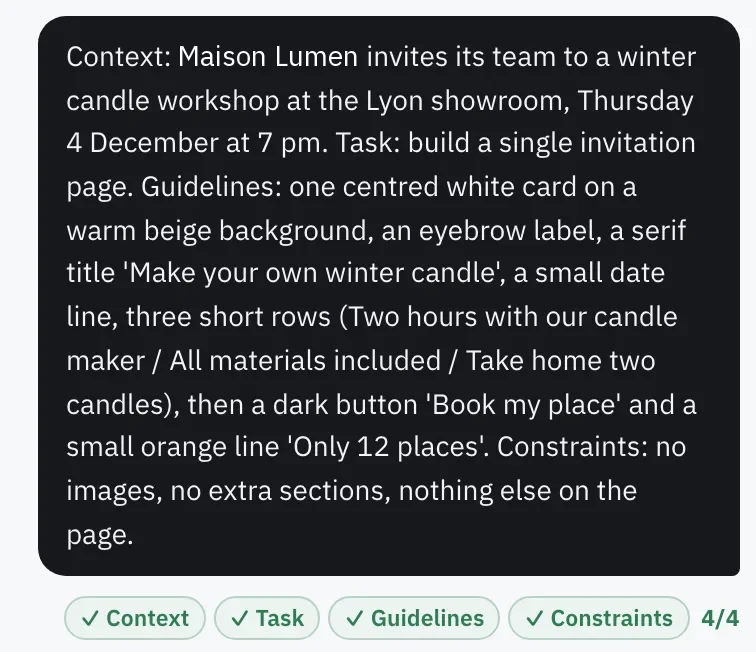 One request with its four parts labelled and checked off, 4 out of 4: the workshop details are made-up exercise material.
FAQ
What are good prompt engineering exercises for beginners?
Start with context exercises (1 to 4 above): they ask for nothing technical, only for the details you already know and forgot to write. Then move to the task and guidelines, and finish with constraints.
How do I know my rewritten prompt is better?
Run the weak and the stronger version in separate, new conversations and compare. Ask whether you could send the answer as it is, or whether you would have to redo it. The prompt checker in this article also shows which of the four parts your text carries.
How long should a prompt engineering exercise take?
About ten minutes each. Write, run, compare, rewrite once. Longer is not better: a second rewrite fixing one missing thing is enough.
Do these exercises work with any AI assistant?
Yes. They use plain-language requests, so you can run them in the assistant your company uses. Results differ from one assistant to another, which is a reason to compare on your own tasks.
Can I use real company data in the exercises?
Check your company's rules first, and use made-up or anonymised material when in doubt. The model answers above use invented names and figures on purpose.
Sources
- Anthropic, Prompting best practices: "brilliant but new employee" and the colleague test (checked 15 November 2026).
- OpenAI, Prompt engineering guide: the junior coworker comparison and explicit instructions (checked 15 November 2026).