On this page
Agentic AI examples are easy to find and hard to trust: most lists are written by vendors, with no source. This page keeps to what companies and vendors say in their own words, and says plainly which examples are named company cases and which are patterns from documentation. If you want to learn to build AI agents without code, start by seeing what a good agent job looks like.
Three cases, in the companies' own figures
Klarna (27 Feb 2024), Salesforce and DXC, in their own words. All self-reported.
What makes AI agentic
An agentic AI system is one where the model chooses its own steps and uses tools to reach a goal. Anthropic draws the line this way: a workflow is a system where models and tools are "orchestrated through predefined code paths", while in an agent the model decides how to get there (Anthropic, Building effective agents). A chatbot answers; an agent also acts, for example by issuing a refund or updating a record. For a fuller definition, see what AI agents are; here we stay with examples.
Eleven agentic AI examples from named companies
Every figure below is self-reported by the company, or by Google Cloud in its list of customer use cases, and none has been audited by anyone else. LUXGEN, Deloitte, Workday, Avalara, Manhattan Associates and Onix are described as in Google Cloud's list of customer use cases (updated 22 April 2026). Read them as what each company chose to say.
Customer service
Klarna: one month after launch, its AI assistant had handled 2.3 million conversations, two-thirds of its chats, in more than 35 languages. It covers refunds, returns, disputes and payment questions. Klarna reports 25% fewer repeat inquiries, and customers can still ask for a live agent (Klarna, 27 February 2024).
Salesforce: its Agentforce agent on help.salesforce.com has passed five million conversations, resolving more than 63% of them instantly (Salesforce).
Zendesk: customers write plain-English instructions for agents that connect to tools such as Jira and Google Drive. In one example, an agent spots a surge of similar tickets, opens a Jira issue, alerts engineers in Slack and updates affected customers. Zendesk reports 1 million custom agent executions in seven weeks of early access and up to 80% shorter human handle times (Anthropic customer story).
LUXGEN: the Taiwanese car maker's agent answers customer questions on its LINE account and reduced the workload of human service agents by 30% (Google Cloud list).
Deloitte: a "Care Finder" agent helps care seekers find in-network providers, often in under a minute against a 5 to 8 minute average call (Google Cloud list).
HR
Workday: its Sana Self-Service Agent finds information and handles everyday HR and finance tasks, with over 300 skills across pay, time and absence. Google Cloud's list gives no result figure (Google Cloud list).
Finance, insurance and legal
DXC: Claude-powered agents across its 14,000-person insurance business. DXC reports that documents are classified in under a second, where review used to take 40 to 50% of expert claims time. Agents work within set authority levels, humans own the checkpoints on weighty decisions, every action is recorded, and about 1% of insurance decisions are autonomous today (DXC with Claude).
Avalara: its Avi agent coordinates with compliance agents to calculate taxes and file returns. No result figure is given (Google Cloud list).
Spellbook: review agents that work inside Microsoft Word, applying a legal team's own playbooks. Spellbook reports about 530,000 contract reviews a month and a turnaround cut from about 10 hours of lawyer work to about one. Lawyers accept or reject the edits and get citations they can check (Anthropic customer story).
Operations
Manhattan Associates: its "Active Agents" act as digital teammates for warehouse, transport and order management, monitoring work, resolving exceptions and automating tasks. No figure is given (Google Cloud list).
Onix: a risk and compliance agent that automates compliance reviews, cutting review times from weeks to minutes, in the wording of Google Cloud's list (Google Cloud list).
Eleven named cases, by department
Customer service
- Klarna
- Salesforce
- Zendesk
- LUXGEN
- Deloitte
HR
- Workday
Finance, insurance, legal
- DXC
- Avalara
- Spellbook
Operations
- Manhattan Associates
- Onix
Self-reported by the companies or as listed by Google Cloud.
Notice what is missing: most of these sources do not give the cost of the agent, the share of mistakes, or the cases it handed back. Ask for those before you copy anyone.
Patterns from vendor documentation
Beyond named cases, Microsoft's training documentation lists typical uses by department and separates two kinds. A conversational agent responds when someone asks. An autonomous agent acts on a schedule or a trigger, without anyone starting each step (Microsoft Learn, use cases for agents). These are vendor examples, not customer results.
Two kinds of agent in Microsoft's documentation
Conversational agent
- Responds when someone asks
- Example: answers benefits questions
Autonomous agent
- Acts on a schedule or trigger
- Example: watches a mailbox for forms
- Updates the HR system, sends confirmations
Source: Microsoft Learn, use cases for agents. Vendor example, not a customer result.
Customer service
- Order and return requests: the agent answers order status questions and handles returns, deflecting common contacts from live agents.
- Refunds with tools: Anthropic notes that support suits agents because they can pull customer data and order history and take actions such as refunds.
HR and IT
- Employee self-service HR: answers on vacation balances, benefits, policies and onboarding steps, without routing each question to an HR specialist.
- IT helpdesk: walks employees through password resets or VPN setup, or submits the ticket itself.
- Benefits enrollment (Microsoft's fictional Contoso example): a conversational agent answers questions while an autonomous one watches a mailbox for completed forms, updates the HR system and sends confirmations.
Finance and legal
- Invoice and expense processing: the agent reads invoices or expense reports, validates line items against policy, approves or escalates on thresholds, and updates the accounting system.
- Contract processing: it extracts key terms, checks them against templates and compliance requirements, and flags exceptions for legal review.
Operations and sales
- Supply chain monitoring: it watches inventory and supplier confirmations, spots shortfalls and triggers reorders.
- Compliance and audit support: it scans records for policy gaps and alerts people to items needing review.
- Lead qualification: it researches and scores incoming leads and routes the best ones to a salesperson with a summary.
Software is the other place agents work well (see Codex vs Claude Code for two coding agents compared). Anthropic points out that code can be verified by automated tests, so an agent can check and revise its own work.
What every example needs
Read the cases and the lists again: the same five things show up each time.
What every agentic AI example needs
- A narrow jobOne task with a clear end
- A short tool listWhat it may read or change
- A limit on authorityThresholds where a person decides
- A recordEvery action logged, replayable
- A real-case testChecked on real messages first
- A narrow job. Refunds and returns, or invoice checks, not "help the customer".
- A short list of tools. What the agent may read and what it may change, decided by a person.
- A limit on authority. Thresholds above which a human decides. DXC's checkpoints and the invoice thresholds are the same idea.
- A record. If you cannot replay what the agent did and why, you cannot supervise it.
- A test on real cases. Klarna and Salesforce report results from real conversations, not demos.
Employees can learn these five habits by practising, not by reading. On Tokenacademy, learners write an agent of their own in plain words (a role, rules, tools and skills) and test it on real customer messages. They can also connect it to simulated company tools on a made-up company, read only, so no real data is ever at risk. Each learner gets a sandbox of their own and nothing to install. To plan the rollout, see the 90-day plan to train employees on AI; for the adoption picture, AI adoption statistics. To see a session, book a demo.
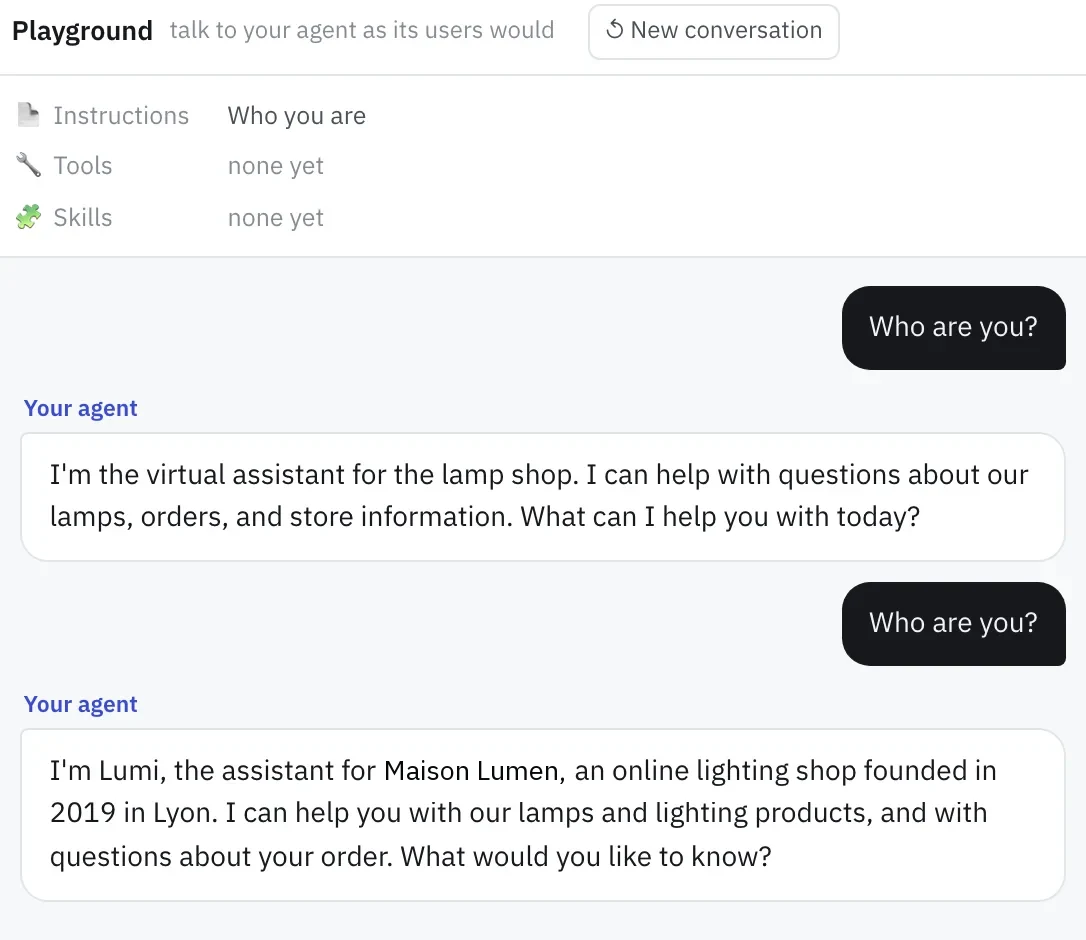 The same question, Who are you?, answered before and after the agent is given a role.
FAQ
What is an example of agentic AI?
A customer service agent that reads an order, decides the refund is due and issues it. Klarna describes an assistant that handles refunds, returns and disputes across more than 35 languages.
What is the difference between agentic AI and generative AI?
Generative AI produces content when asked. Agentic AI uses a model to choose steps and use tools toward a goal, so it can act, for example by updating a record.
Is a chatbot agentic AI?
Not by itself. A chatbot that only answers questions is not. One that can pull a customer's order history and act on it, as in Anthropic's customer support example, is moving into agent territory.
Which departments use agentic AI first?
Customer service and software are the best documented in the sources above. HR and IT self-service, invoice processing, contracts and supply chain monitoring are the common patterns in vendor documentation.
Can agentic AI work without humans?
It depends on the job, and the cases above differ. Salesforce reports that its agent resolved more than 63% of conversations instantly, while DXC says about 1% of its insurance decisions are autonomous today, and keeps human checkpoints on weighty decisions.
Sources
Checked on 3 November 2026. Every company figure is self-reported.
- Anthropic, Building effective agents: workflows versus agents, customer support and coding.
- Klarna press release, 27 February 2024: the assistant's first month.
- Salesforce, Agentforce on its help site: conversations and resolution rate.
- DXC with Claude: insurance claims, authority levels and audit.
- Google Cloud, real-world gen AI use cases: LUXGEN, Deloitte, Workday, Avalara, Manhattan Associates and Onix, as listed by Google (last updated 22 April 2026).
- Anthropic customer stories: Zendesk and Spellbook: agent actions and figures.
- Microsoft Learn, use cases for agents: conversational and autonomous agents by department.