On this page
Codex vs Claude Code, for someone who does not write code, in three lines (facts checked 30 Oct 2026):
- Your company already pays for ChatGPT Business or Plus? Start with Codex: it is included, and it runs inside the ChatGPT apps.
- Your company already pays for Claude Team or Pro, or you want agents wired to your own tools? Start with Claude Code: it is included from Pro, with MCP connectors, skills and a rules file.
- Training a team? Teach the habit, not the product: say what you want precisely in the first message: each step an agent takes re-reads the conversation so far.
Codex vs Claude Code side by side
Claude Code vs Codex, checked 30 Oct 2026
Claude Code (Anthropic)
- Terminal, IDE, desktop, web, phone
- From Pro: $20 a month ($17 yearly)
- Team seat: $25 a month ($20 yearly)
- MCP tools; not on the Free plan
Codex (OpenAI)
- ChatGPT apps, CLI, IDE, cloud
- From Free; Go $8, Plus $20 a month
- Business seat: $25 a month ($20 yearly)
- Model choice moves allowance up to 70 times
Anthropic: claude.com/pricing, code.claude.com. OpenAI: learn.chatgpt.com/docs/pricing.
Prices are those the vendors' pages showed on 30 Oct 2026. OpenAI's pricing page carries no "last updated" date, so treat any figure as a snapshot and re-check it before you buy. Where each runs: Claude Code in a terminal, IDE extensions, a desktop app, the web and the Claude mobile apps; Codex in the ChatGPT desktop, mobile and web apps, a CLI, an IDE extension and Codex Cloud.
What can a non-developer build with each?
Both take a request in plain words and do the work in a project folder, so neither needs the person to read code.
Anthropic describes Claude Code as something you tell, "in plain language", what you want, then it "plans the approach, writes the code across multiple files, and verifies it works" (Claude Code overview). It can read a Google Drive document, update a Jira ticket or pull data from Slack through MCP, and it follows a CLAUDE.md file of your rules.
OpenAI's Codex documentation lists the ChatGPT desktop, mobile and web apps among its surfaces, with sections on files, browser use, scheduled tasks and sites (Codex docs).
On Tokenacademy, learners with no technical background, working with the agent their organization chose, build a web page, a chart, a small tool or an agent of their own with either one, and never see the code. To go further on the agent side, read how to build AI agents without code.
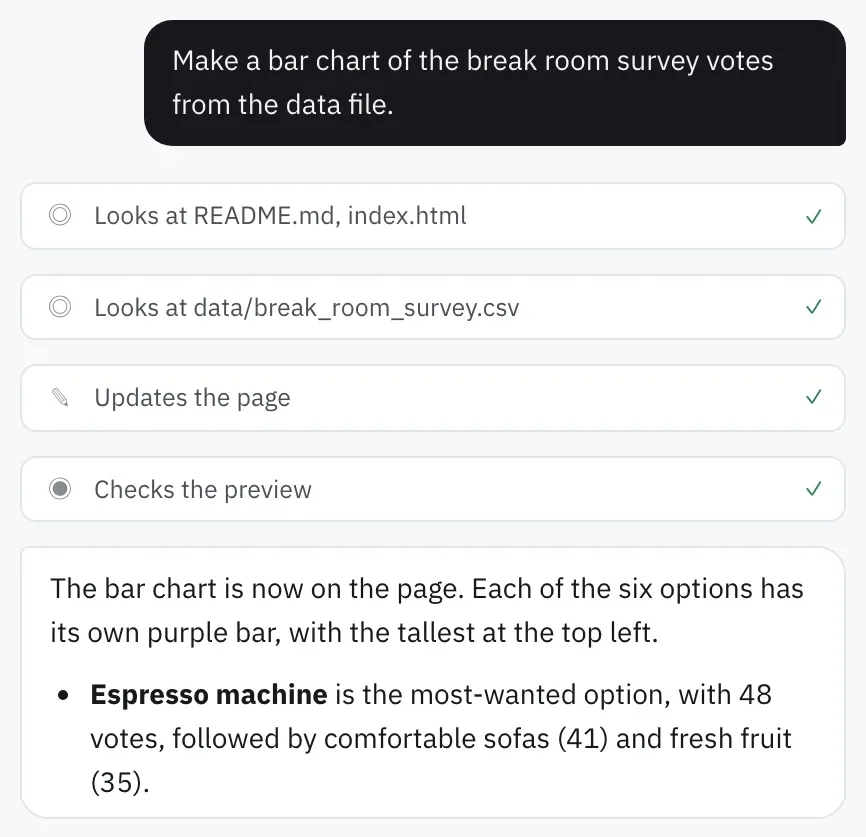 The learner asks for a result; the session lists each step the agent took.
What drives cost in both
An agent does not answer once. Each step it takes re-reads its own instructions and the conversation so far, then adds what it found.
Anthropic's cost guide says usage grows with the context the agent re-reads. A vague request ("improve it") gets redone, a request that says what to change is done once.
Cost is steps times what each step reads
- One requestA short message in plain words
- Work in stepsLooks, changes, then checks
- Each step re-readsInstructions and the conversation so far
- Precise first requestCosts less: fewer rounds, fewer re-reads
After Anthropic's cost guide: usage grows with the context re-read.
To see how many tokens your own text makes, try the free token counter or read what a token is; to practise a precise request, play Prompt Golf. New to agents? Start with what AI agents are, or see agentic AI examples.
Codex vs Claude Code pricing: what you pay for
Claude Code comes with a Claude plan. Pro is $20 a month ($17 billed yearly). Max starts at $100. A Team standard seat is $25 a month ($20 billed yearly), and a Premium seat $125 ($100 yearly). Enterprise is $20 a seat billed yearly, 20 seats minimum, with usage billed at API rates. Every plan has limits on a rolling five-hour window, and paid plans add weekly ones (Claude pricing).
Codex comes with ChatGPT. Free is $0 and Go $8 a month. Plus is $20. Pro starts at $100. Business is $20 a user billed yearly, $25 monthly. Enterprise and Edu are "Contact sales". With an API key, Codex is billed at API rates (Codex pricing).
Worth knowing: on Plus and Business, OpenAI estimates local messages per five hours by model. GPT-6 Luna gets 350 to 3,000. GPT-6 Astra gets 5 to 45. Picking the model changes your allowance by up to about 70 times, and Codex's credit rates move the same way: 2.5 credits per million input tokens on Luna, 250 on Astra.
For a sense of heavy use, Anthropic's cost guide puts the average across enterprise deployments at around $13 per developer per active day. That is a developer's figure, not a trainee's.
Where each one is weak
Claude Code
- Its install guide starts in a terminal. A non-technical user should start from the desktop app's Code tab, which Anthropic says includes Claude Code without a separate install.
- Limits reset every five hours and again each week, so check your plan's limits before a long session.
Codex
- OpenAI does not publish limits for Free and Go.
- On Plus and Business, GPT-6 Astra lists 5 to 45 local messages per five hours against 350 to 3,000 for GPT-6 Luna, so the model you pick sets your allowance.
Both
- Both ask your approval for risky actions. By default Codex runs with network access off. Anthropic's manual mode starts read-only and asks before it edits files or runs commands (Anthropic security, OpenAI approvals).
What happens to your data?
Anthropic's rules depend on the plan. On Team, Enterprise and the API, Anthropic does not train on code or prompts sent to Claude Code, and keeps them 30 days. On Free, Pro and Max you choose; with training allowed the retention is 5 years, without it 30 days (Claude Code data usage).
For Codex, OpenAI's published data policy covers the API: data sent to it is not used to train OpenAI models unless you opt in, with abuse logs kept up to 30 days (OpenAI, your data). Ask OpenAI for the terms of your plan before putting customer data in either.
On Tokenacademy, learners do not use their own accounts: the agent runs in a sandbox of their own with nothing to install and no AI account to create. The checklist is in the four properties of a safe practice environment. Where the sandboxes run is on our privacy page.
Which to pick: four questions
Which agent first? Four questions
- What is already licensed?ChatGPT Business/Plus: Codex. Claude Team/Pro: Claude Code
- Where do people work?ChatGPT: Codex. Claude apps, MCP: Claude Code
- Is budget the limit?Codex Free $0, Go $8; Claude Code Pro $20/month
- Still unsure?Run one small task on both; compare results
Plans and surfaces: Anthropic and OpenAI documentation, checked 30 Oct 2026.
For the plan around the choice, see how to train employees on AI in 90 days. On Tokenacademy an organization chooses which agent its people practise with: book a demo to see one.
FAQ
Is Codex better than Claude Code for non-coders?
It depends on what your company already licenses. Both take plain-language requests: choose the one you hold, then compare them on one real task.
Is Codex cheaper than Claude Code?
At entry level, Codex is included on Free ($0) and Go ($8 a month), while Claude Code starts at Pro, $20 a month. See the pricing section for the rest.
Is Claude Code free?
No. Anthropic's pricing page shows Claude Code as included from Pro, not on Free (Claude pricing).
How do the usage limits compare?
Claude plans reset on a five-hour window, with weekly limits added on paid plans. Codex lists local messages per five hours by model for Plus and Business.
Can I use both?
Yes. They are separate products with separate plans. Anthropic notes that Claude Code can read a repository's AGENTS.md in place of a CLAUDE.md (overview).
Sources
All opened on 30 October 2026.
- Anthropic: Claude Code overview, pricing, cost guide, security and data usage.
- OpenAI: Codex docs, Codex pricing, approvals and security and your data.